There are various types of equipment that help make sure the high pressure gas found in many types of gas cylinders is held and dispersed at a controlled, safe level. This type of equipment includes regulators, caps and other accessories.
- Regulators - these attach to gas cylinder valves to bring the high pressure of the cylinder contents down to a usable, safer, and consistent pressure.
- Caps, valve guards, and pressure relief devices - these are all designed to make the use of gas cylinders safer, either by protecting the valve and valve stem or by preventing an unsafe increase of pressure in the cylinder.
Read on for more detail about the functions of and best practices for using this type of equipment
Regulators
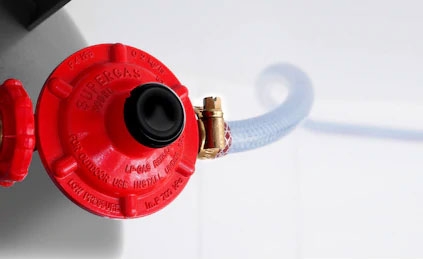
A regulator is a device designed to regulate the delivery pressure of a gas from a compressed gas cylinder. The regulator does not handle the flow of gas or measuring the flow, unless it is also equipped with a flow meter. It only reduces the high pressure from a cylinder to a lower, more usable pressure.
Regulators should be closed before opening a valve on a compressed gas cylinder. Valves should be opened slowly. Any valves that are intended to be opened by hand, like those with a hand wheel, should not be forced with a tool to prevent putting sudden and excessive pressure on the regulator. If a hand wheel is not operating, the cylinder should be repaired.
When a cylinder is no longer in use, the regulator should not be used as the shut off mechanism. The valve should be closed, and the pressure bled from the regulator using the adjustment screw before the cylinder is stored.
Whenever possible, always stand to the side of a regulator, so that you are not directly in front of or behind the face. Regulators explode forwards or backwards, so staying out of that line is the safest place in case of an explosion. Unless the regulator has a flow meter, direct the face of the regulator upwards. Also, when adjusting the valve, do not reach over the regulator to make the adjustment, but set up the cylinder so that you have the valve between yourself and the regulator.
Grease or oil or other combustible solvents should never be used to clean a valve or regulator. These solvents can make certain compressed gases like oxygen combustible. Regulators for any combustible gas should be cleaned carefully after each use to prevent residue from acting as a combustible fuel. Regulators should also be inspected for leaks regularly using water and a non-petroleum based soap; a leaking regulator will bubble.
Only on compressed cylinders containing non-toxic gas, the valve should be “cracked” before attaching the regulator. Cracking is simply opening the valve slightly and closing it again, to blow out any dust or dirt before attaching the regulator.
Caps
Caps are exactly what they sound like, metal covers that completely enclose the valve. These are typically used during transportation of a gas cylinder or for long-term storage. They come in a variety of standard and oversized heights with several threading dimensions. Caps typically have a 1” hole for venting in the case of leaks, preventing a build-up of pressurized gas within the cap, but vented plugs can be purchased for the hole.
Valve Guards
Valve guards are designed to provide impact protection for the valve without blocking access to it. They are typically constructed of metal or plastic and have a cage-like or cup-like appearance. Steel valve guards are sometimes designed for use as a replacement for caps, while plastic valve guards are typically designed for cylinders below a certain weight. Valve guards come in a variety of thread sizes and heights to accommodate a wide variety of gas cylinders.
Pressure Relief Devices
A pressure relief device is designed to prevent the pressure in a cylinder from rising if exposed to a heat source. All varieties are designed to burst or melt when the cylinder pressure reaches a certain limit or a temperature threshold is reached, typically marked on the surface of the device. Devices of this type are in a disk shape or plug shape. There are also spring-loaded valves that are designed to open when the pressure reaches a certain threshold. Unlike the disks or plugs that are one-use, spring-loaded valves will typically reseat themselves when pressure has dropped back into safe limits.
Summary
Make sure to familiarize yourself with the risks associated with the use and handling of high pressure gas cylinders, as well as the equipment needed to mitigate those risks. Regulators, caps, valve guards, and pressure relief devices are all pieces of equipment that help maintain safe pressure when working with compressed gases. Understanding these types of equipment and how they’re used puts you in a better position to work with your gas cylinders safely.
Sources
- Virginia Tech Environmental Health & Safety
- Creighton University Environmental Health & Safety
- American Cap Company


